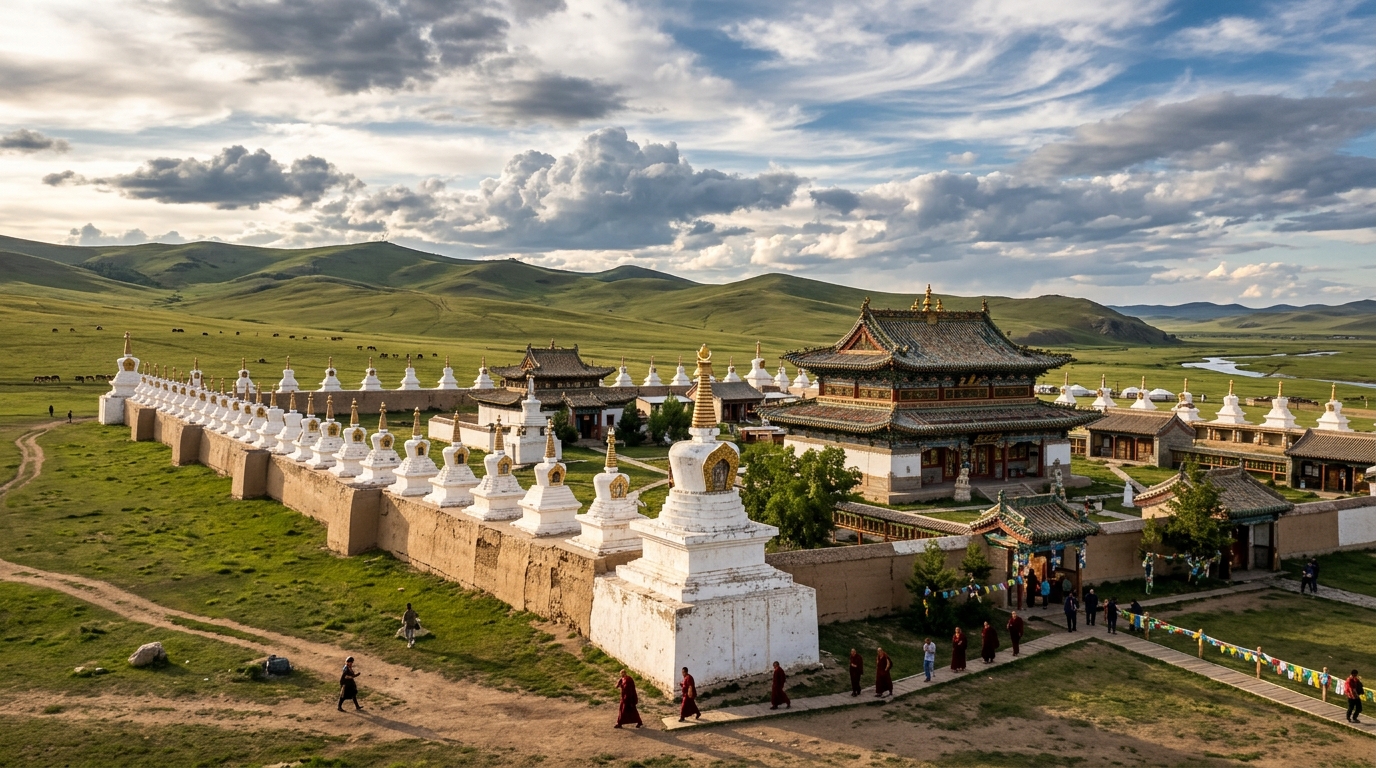
The Cradle of Steppe Empires
For more than two millennia, the lush pastures of the Orkhon River Valley served as the political and spiritual crossroads of nomadic empires—from the Xiongnu and Göktürks to the Uyghurs and the Mongol Empire. Today, the entire valley is a UNESCO World Heritage Cultural Landscape.
Top Highlights of Central Mongolia
- Erdene Zuu Monastery (Эрдэнэ Зуу): Built in 1586 by Abtai Sain Khan using stones from the ruins of ancient Karakorum, Mongolia's oldest surviving Buddhist monastery is enclosed by a monumental wall crowned with 108 gleaming white stupas.
- Kharkhorum Museum: A world-class archaeological museum displaying 13th-century coins, imperial seals, silk fragments, and a scale reconstruction of Ögedei Khaan's cosmopolitan capital as described by William of Rubruck.
- Ulaan Tsutgalan Waterfall: Formed by prehistoric volcanic eruptions and earthquakes, the Orkhon River plunges 24 meters over black basalt cliffs into a lush gorge.
- Tövkhön Monastery: Perched high on a forested granite cliff at 2,600 meters, this hermitage was founded in 1653 by the great sculptor-saint Zanabazar, who created the Soyombo symbol seen on Mongolia's national flag.