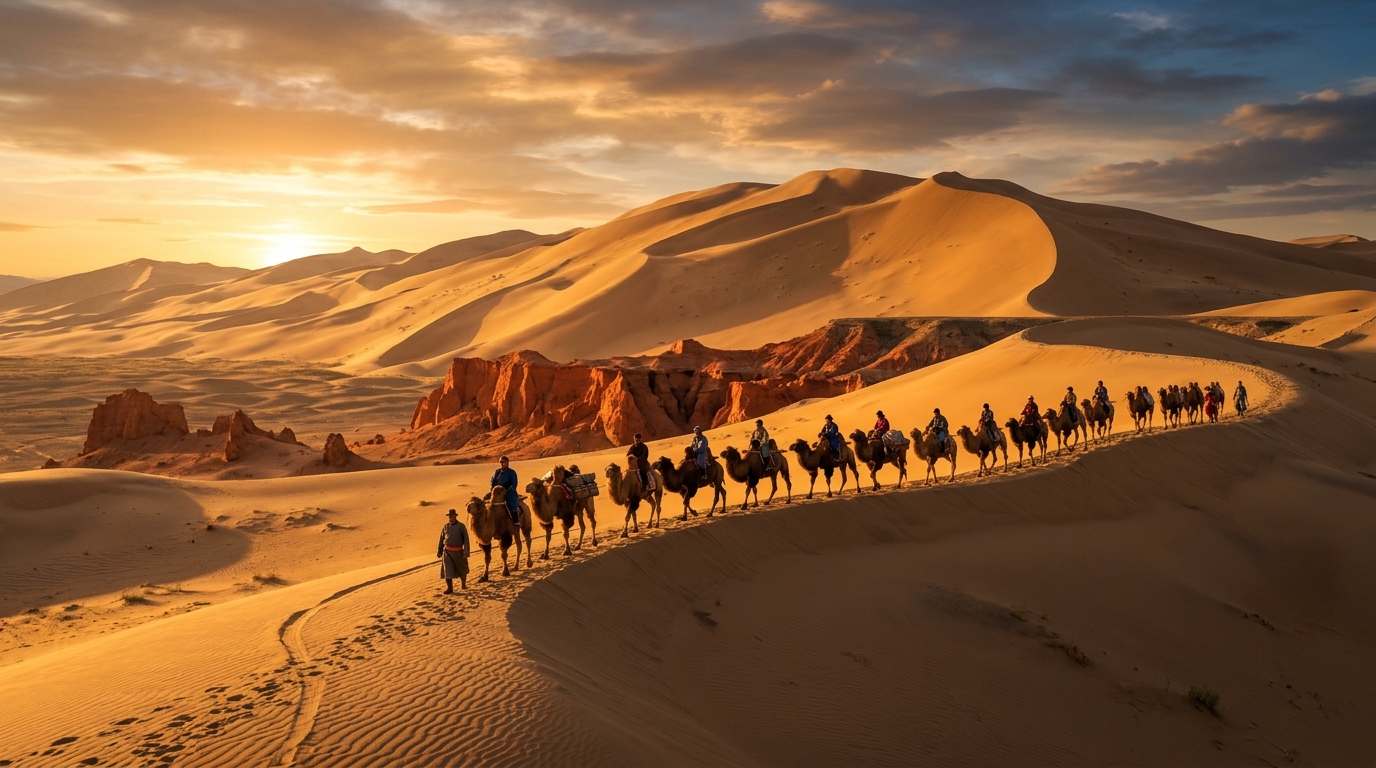
The Gobi Is Not Just Sand—It Is 33 Distinct Ecosystems
Contrary to popular belief, pure sand dunes cover less than 5% of the Mongolian Gobi. Instead, Asia's largest desert is a dramatic mosaic of badlands, emerald oases, volcanic mountains, saxaul forests, and glacier-filled gorges. A classic 6-to-8-day Gobi circuit connects five unmissable wonders:
1. Tsagaan Suvarga (The White Stupa)
In Dundgovi Province, an ancient seabed eroded by wind over millions of years reveals 60-meter-high sheer cliffs striped in bands of rose pink, ochre, and chalk white that resemble a ruined desert city.
2. Yolyn Am (Vulture Valley Ice Canyon)
Located in the Gurvan Saikhan Mountains, this narrow, sheer-walled gorge shelters a thick field of ice that remains frozen well into July. Keep your binoculars ready for bearded vultures (Lammergeiers), Siberian ibex, and adorable pikas darting between boulders.
3. Khongoryn Els (The Singing Sand Dunes)
Towering up to 300 meters high and stretching 180 kilometers long, Khongoryn Els are Mongolia's largest dunes. As wind shifts the dry quartz grains—or as you slide down the crest—the dunes emit a deep, resonant bass hum like a distant airplane engine, earning the name Duut Mankhan ("Singing Sands").
4. Bayanzag (The Flaming Cliffs)
Visit in the final hour before sunset, when the iron-rich sandstone escarpments glow like burning embers across the desert floor. This is the exact site where Roy Chapman Andrews discovered Protoceratops skeletons and fossilized dinosaur nests in the 1920s.
5. Baga Gazriin Chuluu
A surreal labyrinth of granite rock formations rising out of the flat steppe, complete with hidden cave springs and the ruins of a 17th-century meditation monastery.